
How Do Mobile Network Jammers Work?
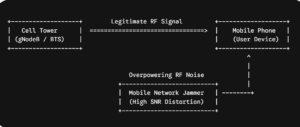
A mobile network jammer operates on the principle of radio frequency (RF) interference, creating a localized “denial of service” zone. Cellular devices and mobile base stations communicate by transmitting signals across specific frequency bands (such as GSM, 3G, 4G LTE, and 5G).
The jamming process functions through three core electronic steps:
-
Frequency Targeting: The device scans or is pre-tuned to match the exact cellular frequency ranges utilized by local network operators.
-
Noise Generation: Inside the circuit, a noise generator (often driven by a voltage-controlled oscillator or VCO) creates a high-power, random interference signal—frequently referred to as “white noise”.
-
Signal Overpowering: The internal power amplifier boosts this garbage signal and transmits it via antennas. Because the jamming signal matches the target frequency and drowns out the legitimate signal with heavy interference, the mobile phone drops its connection, displaying a “No Service” message.
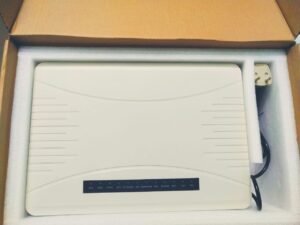
Key Types of Mobile Network Jammers
Classifying jammers based on their build, mobility, and application coverage helps structure your website content effectively for user search intent.
1. Handheld / Portable Jammers
-
Overview: Compact, battery-operated units designed to resemble standard electronic devices or small walkie-talkies.
- Coverage Range: Typically short range (5 to 15 meters).
- Primary Use Case: Long-term installations in high-security locations like correctional facilities (prisons), military barracks, law enforcement command centers, and authorized examination halls.
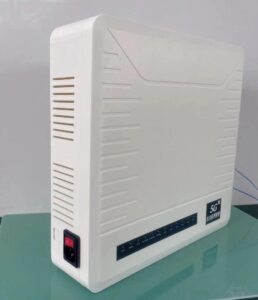
2. Fixed / Desktop Jammers
-
Overview: Stationary, high-powered units plugged directly into standard electrical power outlets, equipped with multiple external antennas and heavy-duty cooling fans.
-
Coverage Range: Medium to wide scale (50 to 200+ meters).
-
Primary Use Case: Long-term installations in high-security locations like correctional facilities (prisons), military barracks, law enforcement command centers, and authorized examination halls.
3. Vehicle-Mounted Jammers
-
Overview: Specialized systems integrated into the electrical architecture of transport vehicles, powered by heavy-duty automotive batteries.
-
Coverage Range: Dynamic perimeter matching the movement of the convoy.
-
Primary Use Case: VIP protection convoys and counter-terrorism tactical units designed to prevent remote-detonated electronic threats.
4. Single-Band vs. Multi-Band Jammers
-
Single-Band Jammers: Focus strictly on legacy frequencies like older GSM or CDMA networks.
-
Multi-Band Jammers: Advanced systems capable of simultaneously blocking a wide spectrum of frequencies—including 2G, 3G, 4G LTE, 5G, Wi-Fi, and Bluetooth—ensuring total communication lockdown across all modern digital protocols.
Key Architectural Components of a Jamming System
Understanding the interior hardware of a mobile network jammer explains how these devices maintain continuous RF disruption across multiple frequencies simultaneously:
-
Voltage-Controlled Oscillator (VCO): Generates the base radio frequency signal that tunes directly to the cellular band intended for blockage.
-
Tuning Circuit: Controls the exact frequency sweep range, ensuring the device covers both uplink (phone to tower) and downlink (tower to phone) channels.
-
Noise Generator: Produces continuous electronic noise to distort the data packets transmitted across the spectrum.
-
RF Power Amplifier: Boosts the low-power noise signal to high wattage, determining the effective operational radius of the blockage zone.
-
Directional or Omni-Directional Antennas: Transmits the amplified noise outward. Omni-directional antennas create a 360-degree coverage bubble, whereas directional panel antennas focus RF energy toward a specific physical zone.
To get More Details Visit Our Website: https://iconnecttechnology.in/